Third party stays in adultery claim
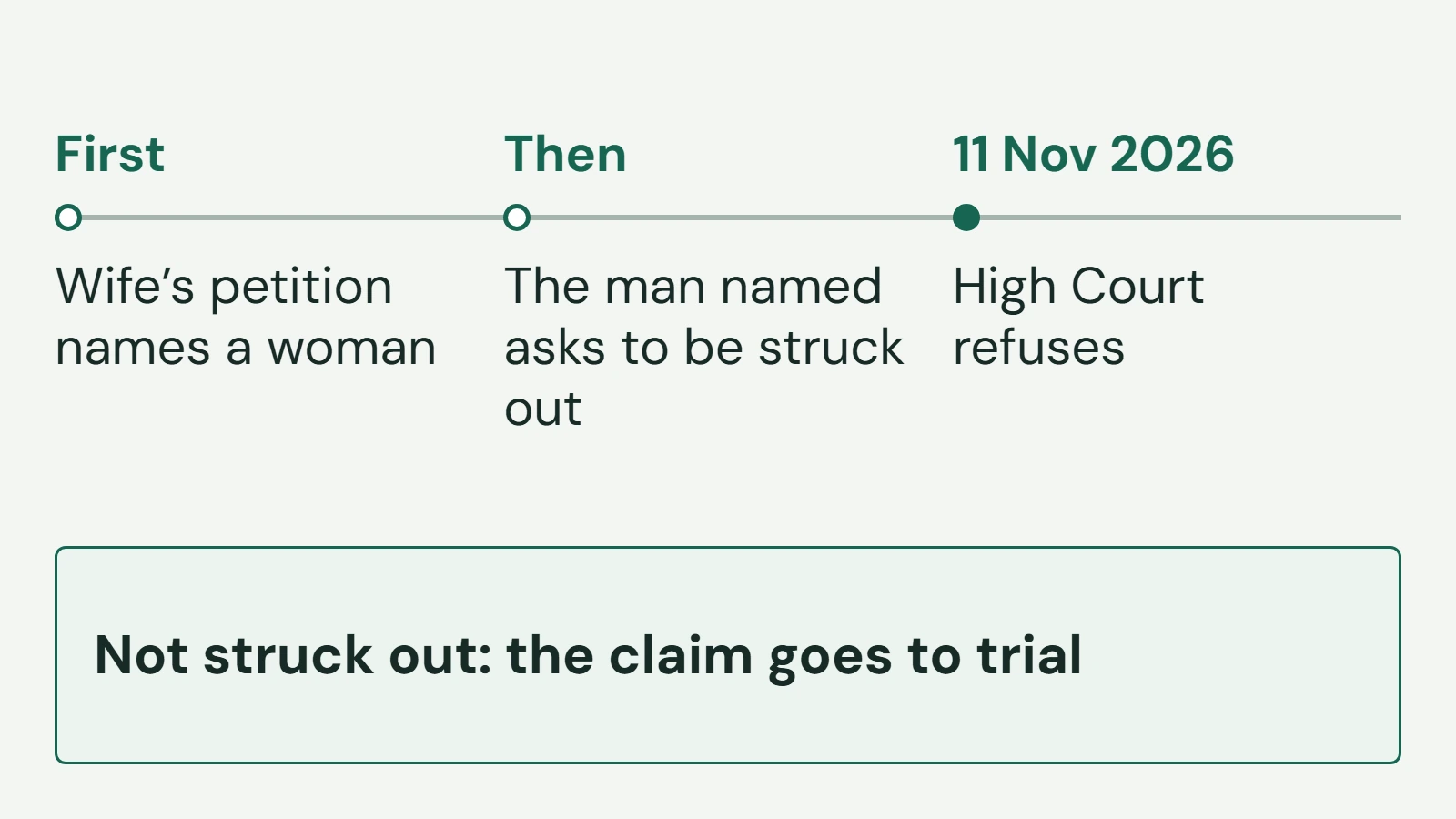
On 11 November 2026 the Pulau Pinang High Court refused to remove a man named in a husband's adultery claim. In this case the court looked only at what was pleaded, not at affidavits. Because the claim gave dates and events, it was left for trial, and the man was ordered to pay RM10,000 costs.
Can someone named in an adultery claim have it struck out before trial?
Section titled “Can someone named in an adultery claim have it struck out before trial?”Not in this case. In this Penang case a man named in a husband’s cross-petition asked to be removed. The court said no: the husband had pleaded specific events, and whether they are true must be tested at trial.
| Item | Detail |
|---|---|
| Case number | PA-33-340-10/2025 (N.Y.P. v D.K.K.Y.) |
| Court | High Court of Malaya, Butterworth, Pulau Pinang |
| Judge | Dr Choong Yeow Choy |
| Decided | 11 November 2026 |
| Issue | Whether the “party cited” in an adultery allegation should be struck out of the cross-petition |
| Outcome | Application dismissed; RM10,000 costs to the husband |
What happened
Section titled “What happened”The wife petitioned for divorce and named a woman as co-respondent over her husband’s alleged adultery. The husband answered and filed his own cross-petition, alleging that the wife had an affair with a man (the “party cited”) and asking that the man pay damages for adultery. That man applied to be struck out under Order 18 rule 19 of the Rules of Court 2012 and rule 103 of the Divorce and Matrimonial Proceedings Rules 1980. He argued that no facts were pleaded, that the claim rested on an alleged confession, and that it was scandalous and an abuse of process. These are only allegations; none has been proved.
What the court decided
Section titled “What the court decided”- Look at the pleading only. On the “no reasonable cause of action” ground, this court looked only at what is written in the claim and did not weigh affidavits. The man’s evidence and messages could not be used at this stage.
- The pleading had detail. It was not a bare accusation. It gave when the relationship was said to have begun, an alleged confession, and alleged events. If proved, these could establish the claim.
- Truth is for trial. Whether the confession was made, and whether the messages disprove the allegations, are evidence questions.
- Here, age and seriousness did not change the test. In this case events said to be many years old did not by themselves make the claim an abuse of process. This court said adultery is serious, but that does not lower the high bar for striking out.
If this were you
Section titled “If this were you”This scenario is made up to show how the ruling applies. It is not a real case.
Hui Min’s husband says in his own divorce claim that she had an affair with a named man, Faisal. He gives dates and says she confessed. Faisal asks the court to remove him and offers messages that deny it.
- The court may look only at what is written in the claim. In this case it did not weigh affidavits or messages at that early stage.
- A claim with dates and events is not a bare accusation. In this case that was enough to go to trial.
- Whether the confession was made may be left for trial. In this case that was an evidence question, not one for a strike-out.
- The events being old may not end the claim. In this case age alone did not make it an abuse of process.
- The result may differ if the claim gave no facts. In this case the court stressed that it was not a bare accusation.
Why it matters for you
Section titled “Why it matters for you”If your spouse accuses you of adultery, the person named may be pulled into the case, and in this case the man could not get out of it just by denying the facts in an affidavit. If you plan to allege adultery, state the particulars, because in this case a claim with detail was not struck out. Another court on other facts may decide differently. Section 58 of the Act deals with naming the person alleged to have committed adultery and with damages against them. Read our adultery guide.