Annulment: refused wedding ceremony
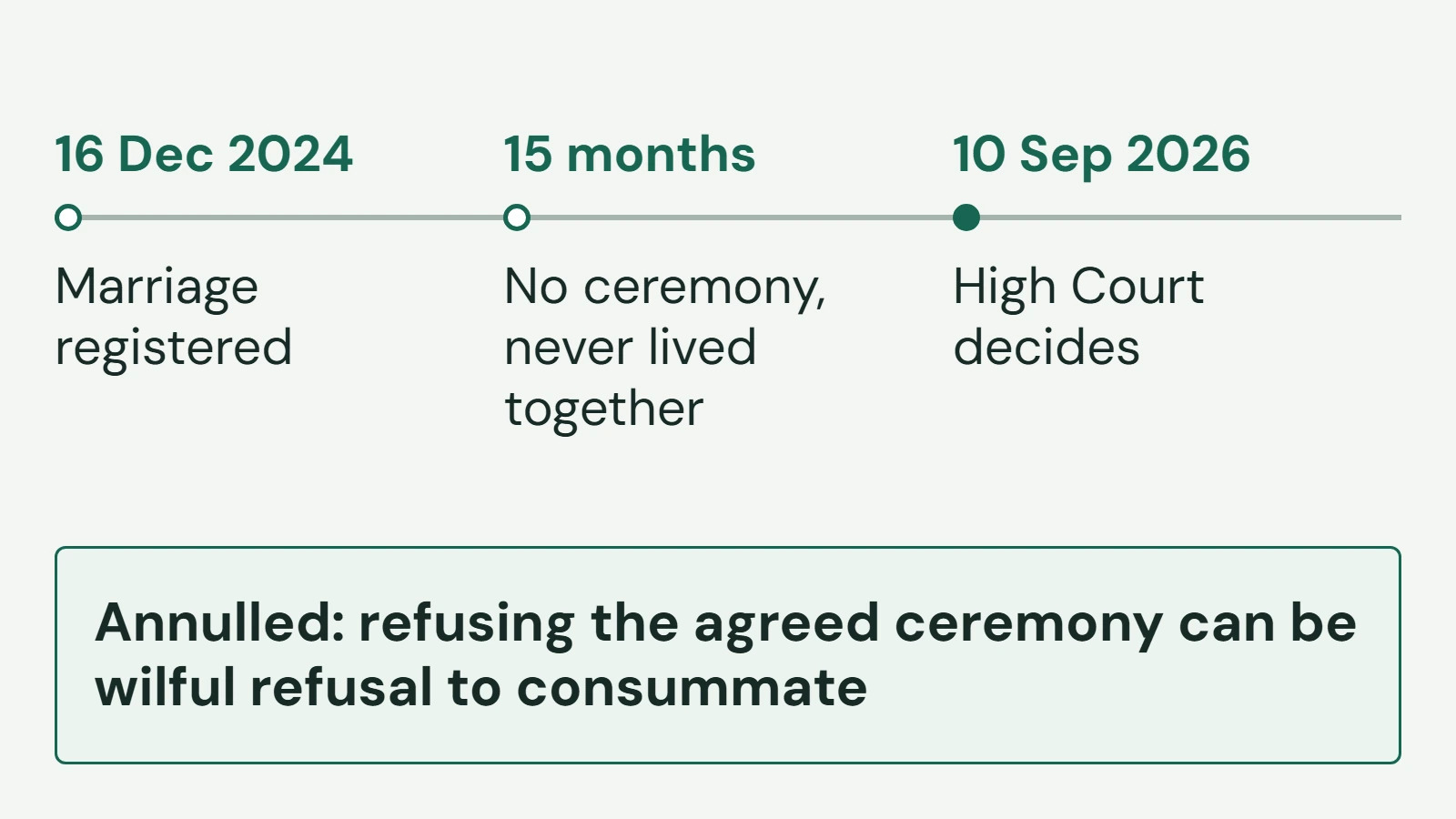
On 10 September 2026 the Melaka High Court annulled a registered marriage that was never consummated. The couple had agreed married life would start only after a Hindu ceremony, and the husband refused to hold it. The court held this was wilful refusal to consummate under section 70(b), and the annulment runs only from the decree.
Can a marriage be annulled if the agreed wedding ceremony never happens?
Section titled “Can a marriage be annulled if the agreed wedding ceremony never happens?”Yes, in this case. In this Melaka case a couple registered their marriage but agreed to live as husband and wife only after a Hindu ceremony. The husband refused to go ahead with it, and the court annulled the marriage as voidable for non-consummation.
| Item | Detail |
|---|---|
| Case number | MA-33-19-04/2026 (K.S. v J.P.) |
| Court | High Court of Malaya, Melaka |
| Judge | Raja Segaran a/l S. Krishnan, Judicial Commissioner |
| Decided | 10 September 2026 |
| Issue | Whether refusing an agreed customary ceremony is wilful refusal to consummate under section 70(b) |
| Outcome | Decree of nullity granted; no costs against the husband |
What happened
Section titled “What happened”K.S. and J.P. met online and decided within about three months to marry. They registered the marriage on 16 December 2024 in Johor Bahru. Before registering they had agreed, on their shared religious understanding, to live together and start married life only after a Hindu ceremony. The ceremony never took place and they never lived together. The wife said she saved for it while the husband lost his job, prepared nothing and turned violent; two police reports and photographs were put in. The husband was served but did not appear.
What the court decided
Section titled “What the court decided”- Annulment, not divorce. Under section 70(b) a registered marriage is voidable if it was not consummated owing to the respondent’s wilful refusal. In this case the court tested this although the husband did not appear, and said a joint decision not to consummate is not enough.
- Here, refusing the agreed ceremony counted. This judge held that where the couple genuinely agreed, before marriage, that married life begins only after a ceremony, a settled and definite decision by one spouse without just excuse not to hold it can amount to wilful refusal. The court set four limits: a shared agreement, a wilful refusal, the petitioner staying ready and willing, and the refusal being the real reason.
- Proved here. The court relied on fifteen months of inaction, the violence and messages seeking paid sexual services, which showed he was not merely delaying. It did not need proof that she had demanded the ceremony, and it gave no weight to unproved suspicions.
- Form of the order. The wife asked for the marriage to be declared void “with immediate effect”. The court refused that wording. Section 73(2) says the decree annuls the marriage only from the time it takes effect, and the marriage is treated as having existed until then.
If this were you
Section titled “If this were you”This scenario is made up to show how the ruling applies. It is not a real case.
Priya and Arun registered their marriage. Before that they agreed to live together only after a temple ceremony. A year later Arun still refuses to hold it, and they have never lived together.
- Priya is asking for an annulment, not a divorce. Section 70(b) covers a marriage that was not consummated because of the other spouse’s wilful refusal.
- Refusing the agreed ceremony may count. In this case it did, because both had genuinely agreed, before the marriage, that married life would start after it.
- She may need to stay ready and willing. In this case the court also required the refusal to be the real reason, not just a delay.
- Evidence matters. In this case the court relied on long inaction, messages and police reports.
- The marriage ends only from the date of the decree. The court refused to say it was void from the start.
Why it matters for you
Section titled “Why it matters for you”In this case the annulment depended on proof that the marriage was not consummated because of the husband’s refusal. Another court on other facts may decide differently. Keep evidence: messages, reports and what you did to prepare. Because the decree works only from its date, your marriage status changes then, not from the wedding date. Read our annulment guide.