Joint vs contested divorce
A joint petition under section 52 of Act 164 is filed by both spouses after two years of marriage. The court must be satisfied both freely consent and the wife and children are provided for. A contested divorce is a single petition under sections 53 and 54, usually after a marriage tribunal referral.
What is the difference between a joint divorce and a contested divorce in Malaysia?
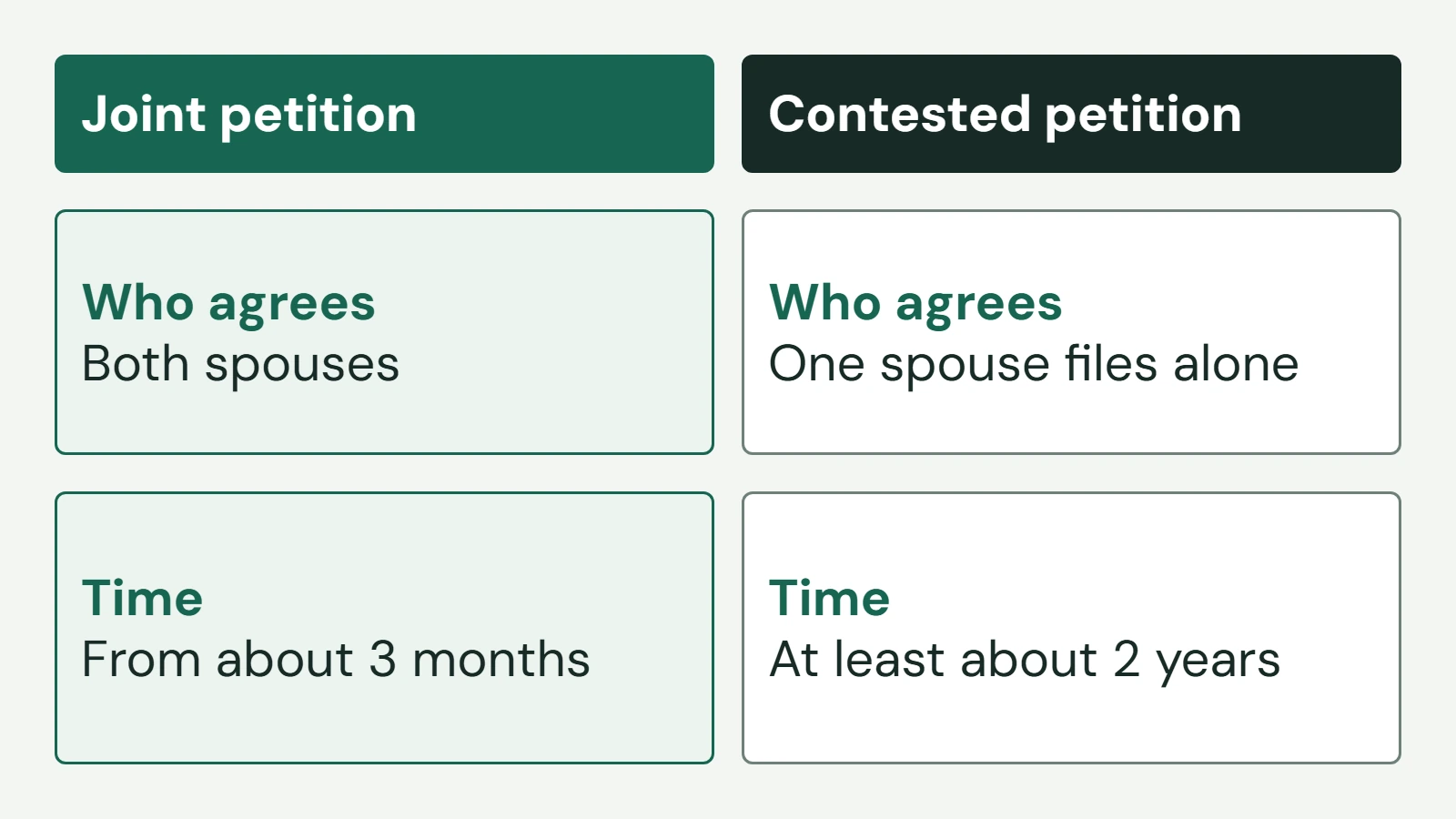
Section titled “What is the difference between a joint divorce and a contested divorce in Malaysia?”In a joint divorce, both spouses agree the marriage should end and file one petition together. In a contested divorce, one spouse files and the other does not agree. The routes sit in different sections of the Law Reform (Marriage and Divorce) Act 1976 (Act 164).
How does a joint petition work?
Section titled “How does a joint petition work?”Section 52 says that if husband and wife mutually agree the marriage should be dissolved, they may present a joint petition after two years from the date of the marriage. The court “may, if it thinks fit” make a decree of divorce once it is satisfied of two things:
- both parties freely consent; and
- proper provision is made for the wife and for the support, care and custody of the children, if any.
The court may attach conditions to the decree. So a joint petition is not automatic: the judge checks that consent is real and the terms protect the wife and children.
The two-year wait is firm. In case no. MA-24F-35-07/2026 (Melaka, July 2026), a couple had agreed in principle to divorce before two years ended. The husband asked for early leave under section 50(2), and the court dismissed the application.
How does a contested divorce work?
Section titled “How does a contested divorce work?”Section 53(1) lets either spouse petition on the ground that the marriage has “irretrievably broken down”. Section 54(1) says the court looks at one or more of four facts:
| Fact | Section |
|---|---|
| The respondent committed adultery and the petitioner finds it intolerable to live with them | 54(1)(a) |
| The respondent behaved in a way the petitioner cannot reasonably be expected to live with | 54(1)(b) |
| The respondent deserted the petitioner for at least two continuous years before the petition | 54(1)(c) |
| The spouses lived apart for at least two continuous years before the petition | 54(1)(d) |
Section 54(2) says the court must consider all the circumstances, including conduct and any child affected. If it would be wrong to dissolve the marriage, it must dismiss the petition. Section 60 lets the respondent prove a section 54 fact of their own and receive relief as if they had petitioned, often called a cross-petition. The single petition guide covers each fact.
Which route needs the marriage tribunal?
Section titled “Which route needs the marriage tribunal?”Only the contested route. Section 106(1) says no one may petition for divorce, except under sections 51 and 52, without first referring the matrimonial difficulty to a conciliatory body that certifies it failed to reconcile the parties. The government page names the Marriage Tribunal at the National Registration Department (JPN).
What do the two routes need side by side?
Section titled “What do the two routes need side by side?”Section
- Joint petition: 52
- Contested petition: 53 and 54
Who files
- Joint petition: Both spouses together
- Contested petition: One spouse
Minimum marriage length
- Joint petition: Two years
- Contested petition: Two years, unless leave is given (section 50)
Ground
- Joint petition: Mutual agreement, free consent
- Contested petition: Irretrievable breakdown shown by a section 54 fact
Tribunal referral
- Joint petition: Not required (section 106(1))
- Contested petition: Required unless an exception applies
Children and wife
- Joint petition: Court must be satisfied of proper provision
- Contested petition: Court decides contested relief (sections 76, 77, 88)
Both routes end with a decree nisi, the provisional order, which cannot be made absolute within three months unless the court shortens it (section 61(1)).
What must the terms cover?
Section titled “What must the terms cover?”Section 57(1)(e) says every petition states the terms of any agreement on maintenance and on dividing assets, or the petitioner’s proposals if there is none. The court can divide assets (section 76) and order spouse maintenance (section 77). For children it applies the welfare test in section 88, covered in the child custody guide.
Our case on spouse agreements explains why a private arrangement may not be enforced. An agreement does not bind the court on children. Section 97 lets the court vary any agreement on a child’s custody or maintenance if that is reasonable and for the child’s welfare. A lump-sum settlement of all future spouse maintenance is not effective until the court approves it (section 80). Section 56 lets court rules allow a spouse to refer an agreement to the court for its opinion on whether it is reasonable.
What are the steps for each route?
Section titled “What are the steps for each route?”- Count the marriage. Two years must have passed, or a Judge must give leave (section 50).
- List what you agree and disagree on: children, maintenance, assets, debts.
- If you agree, prepare a joint petition (section 52) with the proposed terms.
- If you do not agree, go to the tribunal (section 106) and collect its certificate.
- File at the High Court. The government procedure page says applications are either joint or contested.
- Attend mention and trial, then take the decree nisi and apply for it to be made absolute after three months.
From practice: what Yong Jin Man sees
Section titled “From practice: what Yong Jin Man sees”Here is what Yong Jin Man, the author of this site, says about timing on the two routes. These are his estimates from practice, not rules in the Act.
- Joint route: the quickest joint petition he has handled was done within about three months.
- Contested route: he has found that a single petition runs at least about two years, so he advises couples to avoid it where they can.
- After the decree nisi: he expects roughly three months before the decree can be made absolute. Section 61(1) sets that default unless the court fixes a shorter time.
He also corrects a frequent confusion. The “two years” in this area comes from section 50, which stops a petition being presented within two years of the marriage. Couples do not have to live apart for two years before filing, and two years is not the length of a contested case. A couple married for ten years, he notes, does not wait at all for this reason.
A worked example
Section titled “A worked example”This example is made up to show how the rules apply. It is not a real case.
Priya and Wei Ming have been married six years and have a five-year-old child. Both say the marriage is over. They agree the child lives mainly with Priya. They disagree about selling the flat.
- Section 50. Six years have passed, so there is no early-petition problem.
- Section 52. They agree to divorce, so a joint petition is open. The court will want free consent and proper provision for the child.
- The flat. The terms are not settled. They either settle the flat first and file jointly, or Priya files a single petition under section 53.
- If Priya files alone. She needs a section 54 fact, such as two years living apart, and a tribunal certificate under section 106.
- The court’s role. For the flat it applies section 76 and leans toward equal division after weighing contributions, debts, the child’s needs and the marriage’s length. For the child it applies section 88.
Which should you choose?
Section titled “Which should you choose?”A joint petition under section 52 suits couples who agree on everything and who have been married at least two years. A contested petition is for cases where agreement is missing. Ask a lawyer for a written outline of work and fees, and try the divorce costs guide.
Watch: videos on this topic
Section titled “Watch: videos on this topic”Divorce: Single & Joint Petitions
- Channel: MWKA
- Length: 1:01:10
- Uploaded: 2 Jun 2020
- Channel: How & Hospera
- Length: 02:17
- Uploaded: 9 Jun 2023
How to get a divorce in Malaysia? (Both parties agreeable)
- Channel: Veeran & Tan
- Length: 02:07
- Uploaded: 1 Aug 2021
Sources
Section titled “Sources”- Law Reform (Marriage and Divorce) Act 1976 (Act 164), Attorney General’s Chambers. Sections 50, 52 to 57, 60, 61, 76, 77, 80, 88, 97 and 106 read from the text.
- Divorce procedures for non-Muslim couples, Malaysia Government portal.
- eJudgment portal, High Court family judgments.