Divorce costs: questions to ask
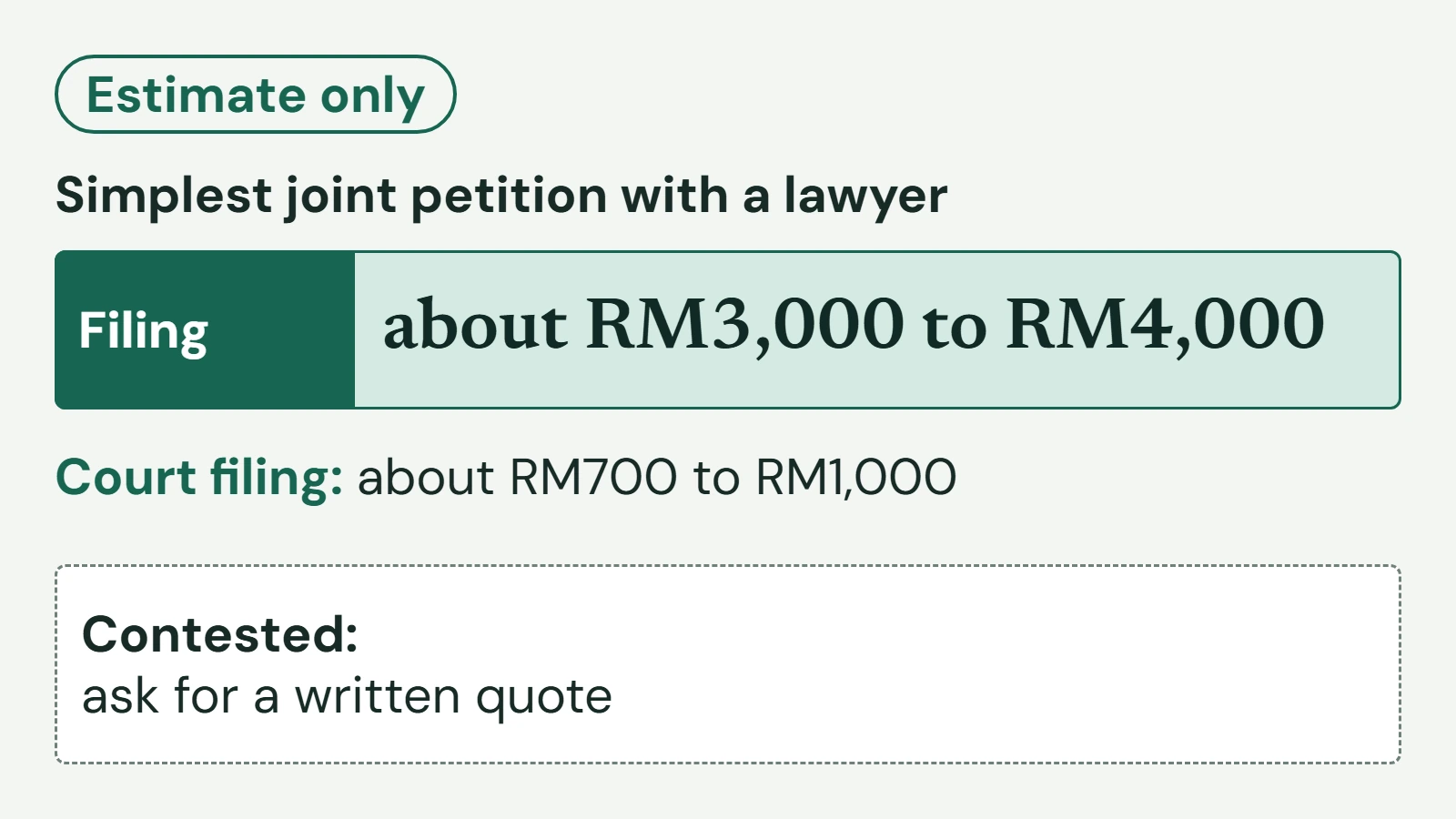
We found no official ringgit schedule for divorce lawyers' fees. Yong Jin Man's estimate from practice is about RM3,000 to RM4,000 for the simplest joint petition. The Legal Aid Department publishes a RM10 registration fee and contribution bands. Ask every lawyer for a written quote that states scope and exclusions.
How much does a divorce cost in Malaysia, and what should you ask before you pay?
Section titled “How much does a divorce cost in Malaysia, and what should you ask before you pay?”There is no single price. The cost depends on the route you take, how much the spouses dispute and how long the case runs. No official ringgit schedule exists for divorce lawyers’ fees. Yong Jin Man’s own estimates from practice are in the “From practice” section below.
What official figures exist?
Section titled “What official figures exist?”Only legal aid has published figures. The Legal Aid Department lists a RM10 registration fee and a contribution that depends on your yearly financial resources. The first category, RM50,000 and below, shows no contribution. Higher categories show contributions from RM500 up to RM50,000. Our legal aid guide has the full table and the application steps.
For the cost of a lawyer, the Malaysian Bar homepage menu we opened showed no fee guidance page. Ask each firm for a written quote and compare them.
What makes a divorce cost more?
Section titled “What makes a divorce cost more?”Costs follow the work. These parts of the process can add work, according to the Act and the government page.
Single petition instead of joint
- Why it can add work: A marriage tribunal referral comes first, except where an exception applies. Lawyers may not appear before the tribunal.
- Source: Act 164, s 106(1), (5)(c)
Contested facts
- Why it can add work: The petitioner must prove adultery, behaviour, desertion or living apart
- Source: Act 164, s 54(1)
Naming a co-respondent
- Why it can add work: An adultery petition must name the other person unless the court excuses it, and may claim damages
- Source: Act 164, s 58(1), (2)
Disputed assets or maintenance
- Why it can add work: The court decides division of assets and maintenance
- Source: Act 164, ss 76, 77
Disputed children’s issues
- Why it can add work: The court applies the welfare test
- Source: Act 164, s 88
Adjournments for reconciliation
- Why it can add work: The court can adjourn at any stage
- Source: Act 164, s 55(2)
Decree nisi and absolute
- Why it can add work: The decree nisi cannot be made absolute for three months unless the court shortens it. Then JPN records are updated.
- Source: Act 164, s 61(1); government page
An agreed joint petition (section 52) usually has fewer disputed parts. Compare routes in our joint or contested guide.
How do courts order costs?
Section titled “How do courts order costs?”“Costs” here means the legal expenses one side may be ordered to pay the other. Two decisions on the eJudgment portal quote Order 59 of the Rules of Court 2012:
- Rule 2(2): costs are in the court’s discretion, and the court decides by whom and to what extent they are paid.
- Rule 3(2): costs normally follow the event, meaning the loser pays, unless the court orders otherwise.
- Rule 8: the court takes into account any settlement offer, the conduct of all parties, any attempt at mediation or other dispute resolution, and any practice direction followed.
So a settlement offer and each side’s conduct can affect the costs order. A claim against a co-respondent has its own rule: section 59(3) lets the court order a co-respondent to pay costs in a husband’s petition where adultery is proved, with two exceptions.
How do you get a written quote?
Section titled “How do you get a written quote?”- Write your situation in a few lines. State the marriage date, whether you expect a joint or single petition, and whether children or assets are disputed. The consultation documents checklist helps.
- Ask each firm for the scope in writing. Which stages does the quote cover: tribunal preparation, petition, mention, trial, decree absolute?
- Ask what is excluded. Ask which services need a separate agreement.
- Ask about court-related and third-party expenses. Ask whether they are included or billed separately, and which could arise in your case.
- Ask what happens if the case changes. Examples: the other spouse contests, a co-respondent is named, or the case settles early.
- Ask about payment. When is each payment due, and how are receipts and any unused funds handled if work ends early?
- Compare like with like. A low number with a narrow scope can cost more in the end than a higher number with a wide one.
From practice: what Yong Jin Man sees
Section titled “From practice: what Yong Jin Man sees”Yong Jin Man, a divorce lawyer and the author of this site, shares the figures below from his own work. They are his estimates from practice. They are not an official fee, not a schedule and not a quote.
- Court filing for a basic joint petition: Yong’s estimate is about RM700 to RM1,000 to register the case.
- Each document has its own fee. In his experience the petition, the affidavits, the statement on the children and the statement on assets are each filed and paid for separately. Affidavits can also carry a small fee per document and per exhibit.
- A joint petition with a lawyer: at market rates, he puts the cheapest case, with no argument, at about RM4,000. He treats about RM3,000 as the floor.
- A contested petition: it costs more, he says, because it runs much longer.
- No refund after a change of heart: in his experience, fees already paid are not returned if the couple reconcile after the decree nisi, because the court has already spent its time.
Use them to prepare your questions, then ask for a written quote as described above.
- Ask for an itemised written quotation. His checklist is a quote that separates professional legal fees; court filing fees; service, commissioning and other disbursements; costs relating to children, maintenance and property; and the extra charges if agreement fails or the matter becomes contested.
- No fixed fee in the Act. Act 164 fixes no lawyer’s fee, and the figures above are his general observations, not a rule.
A worked example
Section titled “A worked example”This example is made up to show how the rules apply. It is not a real case.
Hui Ling wants a divorce. Her husband has not agreed, so she expects a single petition. She asks two firms for quotes and gets two short messages.
- Check the route. A single petition means a tribunal referral under section 106(1), unless an exception applies. Lawyers cannot appear at the tribunal (section 106(5)(c)). She asks each firm whether its quote includes preparing her for it.
- Check the grounds. She plans to rely on two years living apart (section 54(1)(d)). She asks whether the quote covers gathering evidence of that.
- Check the other issues. She has a jointly bought home and one child. Those bring in sections 76 and 88. She asks whether the quote covers contested hearings on them.
- Check the end. She asks if the quote includes the decree absolute application after three months and the JPN update (section 61(1)).
- Compare. One firm’s quote lists stages and exclusions. The other names a single number. She asks the second firm to list what the number covers before comparing.
- Check help. She also checks the Legal Aid Department table to see whether she may qualify.
What should your next step be?
Section titled “What should your next step be?”Ask a local lawyer, such as one of the Kuala Lumpur divorce lawyers, for a written quote against your list.
Watch: videos on this topic
Section titled “Watch: videos on this topic”How Divorce REALLY Works in Malaysia (Civil and Shariah) [Back To Basics]
- Channel: Mr Money TV
- Length: 1:19:40
- Uploaded: 21 Oct 2026
Family Law in Singapore vs Malaysia - Divorce, Mediation & Legal Costs (Ep 1)
- Channel: Eden Law Corporation
- Length: 30:12
- Uploaded: 20 May 2025
Why You Need a Lawyer to Divorce in Malaysia
- Channel: Veeran & Tan
- Length: 03:55
- Uploaded: 8 Aug 2022
Sources
Section titled “Sources”- Law Reform (Marriage and Divorce) Act 1976 (Act 164), Attorney General’s Chambers. Sections 54, 55, 58, 59, 61, 76, 77, 88 and 106 read from the text.
- Legal aid services, Legal Aid Department.
- Divorce procedures for non-Muslim couples, Malaysia Government portal.
- eJudgment portal, High Court family judgments. Order 59 text as quoted in the decisions above.
- Malaysian Bar.
What recent decisions show
| Date | Subject | Outcome |
|---|---|---|
| — | The court allowed the husband's application (Enclosure 147) to take the youngest child to London from 9 to 14 February 2025 and to have access to the child's passport, with no order as to costs, because the wife had agreed on conditions and neither side filed further papers. In the grounds it also said the husband's appeal against costs only needs the Court of Appeal's permission, an appeal court seldom disturbs a costs order, and the costs order was made within the court's discretion under Order 59. |