Children and divorce: preparation
Gather the facts the court uses under Act 164: each child's name, age and sex (section 57), daily routine, schooling, health and caregiving (welfare, section 88), a costed expense list (sections 92 and 93), and your proposed arrangements. Do not coach the children. Take the record to a lawyer.
What should you prepare about your children before a divorce?
Section titled “What should you prepare about your children before a divorce?”Prepare the facts a court uses to decide custody, access and child maintenance. For non-Muslim parents these rules sit in Part VIII of the Law Reform (Marriage and Divorce) Act 1976 (Act 164).
A “child” in this Part means a child of the marriage under 18 (section 87). For the rules themselves, read our child custody guide.
What does the court look at for children?
Section titled “What does the court look at for children?”The child’s welfare is the paramount (first and overriding) consideration
- Section of Act 164: Section 88(2)
- What to gather: A plain account of who does what each day: school runs, meals, bedtime, medical visits
The wishes of each parent
- Section of Act 164: Section 88(2)(a)
- What to gather: Your own written proposal for residence and access
The wishes of the child, if old enough to express an independent opinion
- Section of Act 164: Section 88(2)(b)
- What to gather: Nothing to prepare. Do not ask the child to choose
A child under seven is presumed better with the mother (this can be argued against)
- Section of Act 164: Section 88(3)
- What to gather: How long the current routine has lasted: the court weighs “the undesirability of disturbing the life of a child by changes of custody”
Each child is considered separately
- Section of Act 164: Section 88(4)
- What to gather: A separate note for each child, because the court need not keep siblings together
Conditions on residence, education, religion, access and travel abroad
- Section of Act 164: Section 89(2)
- What to gather: Which of these matter to your family
Advice from a person trained in child welfare
- Section of Act 164: Section 100
- What to gather: Be ready for interviews and a home visit by a welfare officer
Maintenance for each child
- Section of Act 164: Sections 92, 93 and 95
- What to gather: A costed expense list (see below)
What must a divorce petition say about children?
Section titled “What must a divorce petition say about children?”A petition must give “the names, ages and sex of the children, if any, of the marriage” (section 57(1)(a)). It must also state the terms of any agreement on maintenance of the children or, where there is none, the petitioner’s proposals (section 57(1)(e)). In a joint petition, the court must be satisfied that proper provision is made “for the support, care and custody of the children” (section 52).
The court also weighs how a child’s interests may be affected if the marriage is dissolved (section 54(2)).
How do you prepare, step by step?
Section titled “How do you prepare, step by step?”- Write each child’s full name, date of birth and sex. This feeds section 57(1)(a).
- Describe one ordinary week for each child: school, transport, meals, homework, medical visits.
- Note any special needs or health conditions, and who attends the appointments.
- Write your proposal for residence and access, including school holidays and festivals.
- Build the expense list described below.
- Note any existing court order or written agreement about the children. Section 97 lets the court vary an agreement when that is reasonable and for the child’s welfare.
- Take everything to a lawyer and ask which items the court is likely to want.
How do you prepare a child expense list?
Section titled “How do you prepare a child expense list?”Section 92 makes it the duty of a parent to maintain their children by providing “such accommodation, clothing, food and education as may be reasonable having regard to his or her means and station in life”. Section 93 lets the court order maintenance at any time, including while the case is pending.
List recurring costs by child: school fees, transport, food, childcare, medical needs. Keep the receipts you hold. Section 95 says a custody or maintenance order normally ends at 18, but continues for a child who has a disability or is pursuing further or higher education or training, until that ends.
What happens in a welfare report?
Section titled “What happens in a welfare report?”Section 100 says the court shall, whenever practicable, take advice from a person trained or experienced in child welfare. It is not bound to follow that advice. The Melaka High Court case in the table below records that the parties may inspect the report and answer it, and that it is advisory evidence only. Expect interviews and a home visit. Do not rehearse the child.
Can a children arrangement be changed later?
Section titled “Can a children arrangement be changed later?”Yes. Section 96 lets the court vary or rescind a custody or maintenance order where it was based on a misrepresentation or mistake of fact, or there has been a “material change in the circumstances”. Section 101 also lets a parent ask for an injunction to stop the other parent taking a child out of Malaysia while a case is pending.
From practice: what Yong Jin Man sees
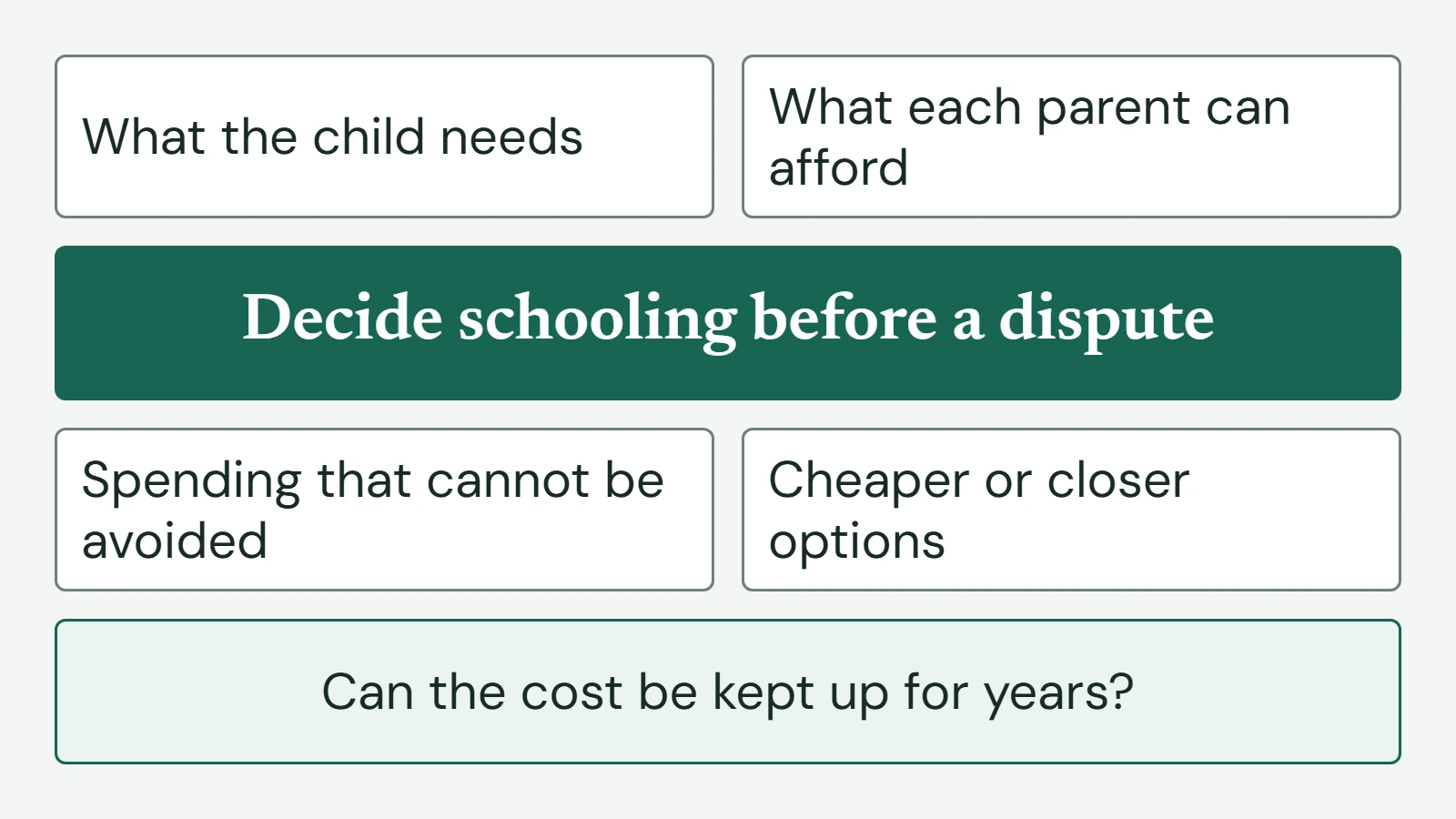
Section titled “From practice: what Yong Jin Man sees”Yong Jin Man advises parents to talk about schooling and activities before a dispute escalates. His practical test is to set the proposed school or classes beside five things:
- what the child actually needs
- what each parent can afford
- the household spending that cannot be avoided
- cheaper or closer alternatives
- whether the cost can be kept up for years, not just the first term
He also says parents may share out areas of responsibility between themselves, for example one deciding on schooling and the other on health, but the split should be written down clearly so that neither parent has to rely on memory later. That is his practical advice; a private split does not take away the court’s power to decide what is best for the child.
A worked example
Section titled “A worked example”This example is made up to show how the rules apply. It is not a real case.
Mei Ling and Daniel are non-Muslims with two children: Aiden, 5, and Chloe, 11. Mei Ling is preparing before seeing a lawyer.
- She writes both children’s names, birth dates and sex, as section 57(1)(a) requires.
- She writes a separate weekly routine for each child, because section 88(4) means each child is considered on their own.
- She notes that Aiden is under seven, so the section 88(3) presumption is in play, and that he has lived in the same home all his life.
- She lists school fees, transport, meals and Chloe’s clinic visits under section 92, with receipts.
- She writes her proposal: both children live with her, and Daniel has weekend and holiday access, as section 89(2) allows.
- She does not ask Chloe where she wants to live. Under section 88(2)(b) that is for the court.
- She takes the file to the consultation.
See also our custody case summary.
What next?
Section titled “What next?”For maintenance rules see alimony and maintenance.
Watch: videos on this topic
Section titled “Watch: videos on this topic”How do I help my child with difficult experiences such as divorce and separation?
- Channel: Child Mind Institute
- Length: 07:35
- Uploaded: 6 Jun 2024
Getting a Divorce with Kids: What Parents Need to Know
- Channel: St. Louis Children’s Hospital
- Length: 03:54
- Uploaded: 23 Mar 2017
These two videos are general guidance for parents from child health organisations in the United States. They are not about Malaysian law.
Sources
Section titled “Sources”- Law Reform (Marriage and Divorce) Act 1976 (Act 164), Attorney General’s Chambers: sections 2, 52, 54, 57, 87 to 89, 92 to 97, 100 and 101.
- Court judgments, eJudgment portal, read through the links in the table.